Search This Blog

Wednesday, September 23, 2015

A friend recently introduced me to the joys sci-fi writer China Mieville who  has a new collection of short stories out titled Three Moments of an Explosion.  


It is not the book, which I have to get, but Rhys Williams' review in The LA Review of books that brought me to the blog in agitation.  It  raises what I think are some pretty profound questions, not the least of which come up at the end:

More is possible, these stories suggest, more is already out there — but only if we acknowledge that what we have, and what we are, is neither necessary nor proper.

It is in this utter, evangelical conviction, that I hear the echo of Jonathan Edwards crying out in the second Great Awakening to the sons and daughters of the Puritan emigrants:  "You are sinners in the hands of an angry God; " and "This world is but a shadow of a better, truer world that is heaven."


The jeremiac call that I see in so many reviews shouldn't be troubling (at least they work hard at the actual work of a review to provide critical thinking and don't simply provide summary and end with a cursory apologetic on the subjective nature of opinion.) We need clarion calls to re-evaluate the current state of affairs.  We need those calls to point to aid and succor, whether it be found in arts, technology, or some hopeful combination thereof.   

Of course, it is not only reviews that make this claim of another, truer, world:

"Only art penetrates … the seeming realities of this world," Saul Bellow asserted in his Nobel Prize acceptance speech"There is another reality, the genuine one, which we lose sight of. This other reality is always sending us hints, which without art, we can’t receive.” Pablo Neruda
One of  Emily Dickinson's so called Envelop Poems
(Lifted from this week's Brain Pickings ) 


It is not this questing for a truer world that niggles or even the claim that art is the truest path there.  Anything/anyone that doubts and prods the self's self-satisfaction in the world is a delight.  


William Blake, Red Dragon.  Brooklyn Museum of Art
Rather, it begins with Williams' assertion that our nature is sinful and flawed, "neither necessary nor proper"  and needs to be replaced with a better nature in order to bring about a better world that raises the hair on the back of my neck. One might manage to shrug off the puritanical ideology easily enough; however, Williams makes a fervid argument that this conviction is a radical response to the status quo:  It is not Mieville's writing per se that makes it so potent for this reviewer; it is rather that the writing can be pinned unwriggling to the template of William's revolutionary necessity.  

Against a false sense of ontological security (a trust in the rightness of our identities, ways of life, and understandings of the world) he draws on and cultivates a style of ontological insecurity that is a defining effect of the Weird tradition

To insist that the unstable is a knowable good—a transformational good that will save not just the reader but civilization as a whole—is is the first step to commodifying the arduous work of resistance.  The gratuitous sensationalizing of that work like we see in this review provides the next step.  Still, all of this might be understood to be the very real joy of a besotted reader.  Unfortunately, it does not end there.


The shift in the final paragraph to an assertion that only Mieville understands the current need for resistance to the old order leads Williams to an outrageously condescending stance toward readers:

Yet I also think it is aiming to do something more: It is attempting to be a literature adequate to our times, and it is attempting to create readers who are adequate as well.

Nebuchadnezzer from Andy White's Blog
Though as Williams goes on to articulate just what that, apparently hypothetical, reader would look like, he twins himself to Mievilles'  supposed agenda of creating the ideal reader.  In the end, it is Williams himself, purportedly speaking on behalf of Mieville, who is attempting to re-create the reader in his own image—the ideal reader adequate for the age.

Wednesday, June 3, 2015

Cloud journal

Koko Head in Oahu

Part of a double rainbow--normal evening event here

Ocean clouds off Waikiki
Nearly cloudless Seoul sky

Where are the clouds for Seoul?

Seoul

Even with its many mountains, these were the only clouds we ever saw.

Back home

Backyard

Hawaiian mountain in clouds
From the rainbow inducing clouds of Oahu to the strangely cloud-free sky above Seoul and back again.  With a brief stop home, my internal clock is deeply disturbed.  Heard a travel writer on NPR refer to this not as jet lag, but "place lag," which was lovely.  Especially so as he liked the effect and said the disorientation added to the magic of travel--its undeniable insistence that you are somewhere strange to you.

Tuesday, May 19, 2015

Cloud journal

Backyard


Backyard
Backyard

Driving to the airport saw this shark with flag cloud


Mountain drawn cumulus behind Honolulu

Firework clouds over the Pacific

As this peripatetic life goes, so goes the cloud journal.  One remarkable thing I've noticed in Honolulu is that there are two distinct cloud environments here.  One exists for the mountains and one for the Pacific Ocean.  The mountains draw darker stratus and pile up the cumulus, while the ocean sketches with cirrus.


Tuesday, May 12, 2015

Cloud journal

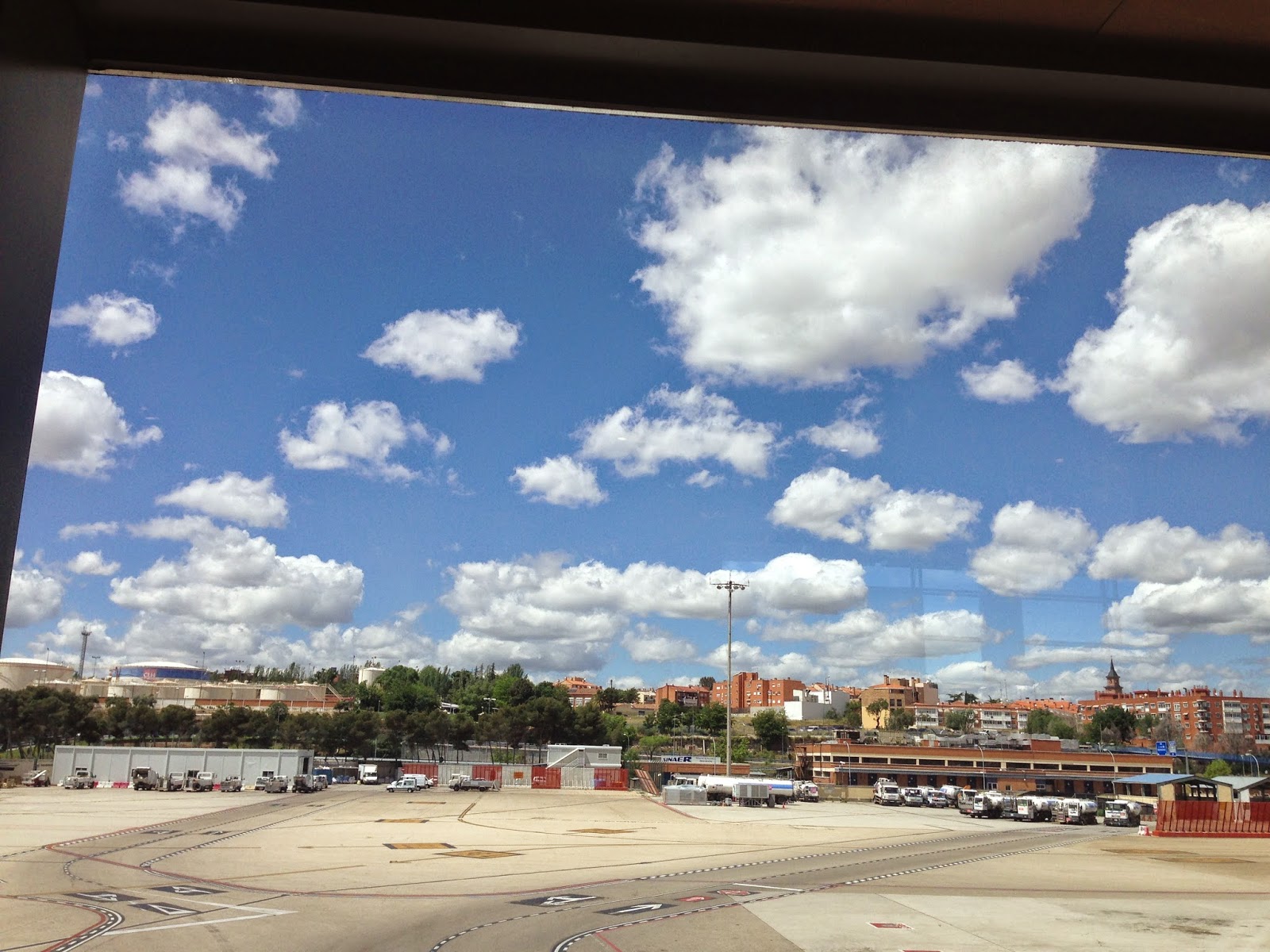
Madrid airport

Edge of Madrid with view of foothills

Edge of Madrid

Hiking in the foothills to the sound of a cuckoo bird

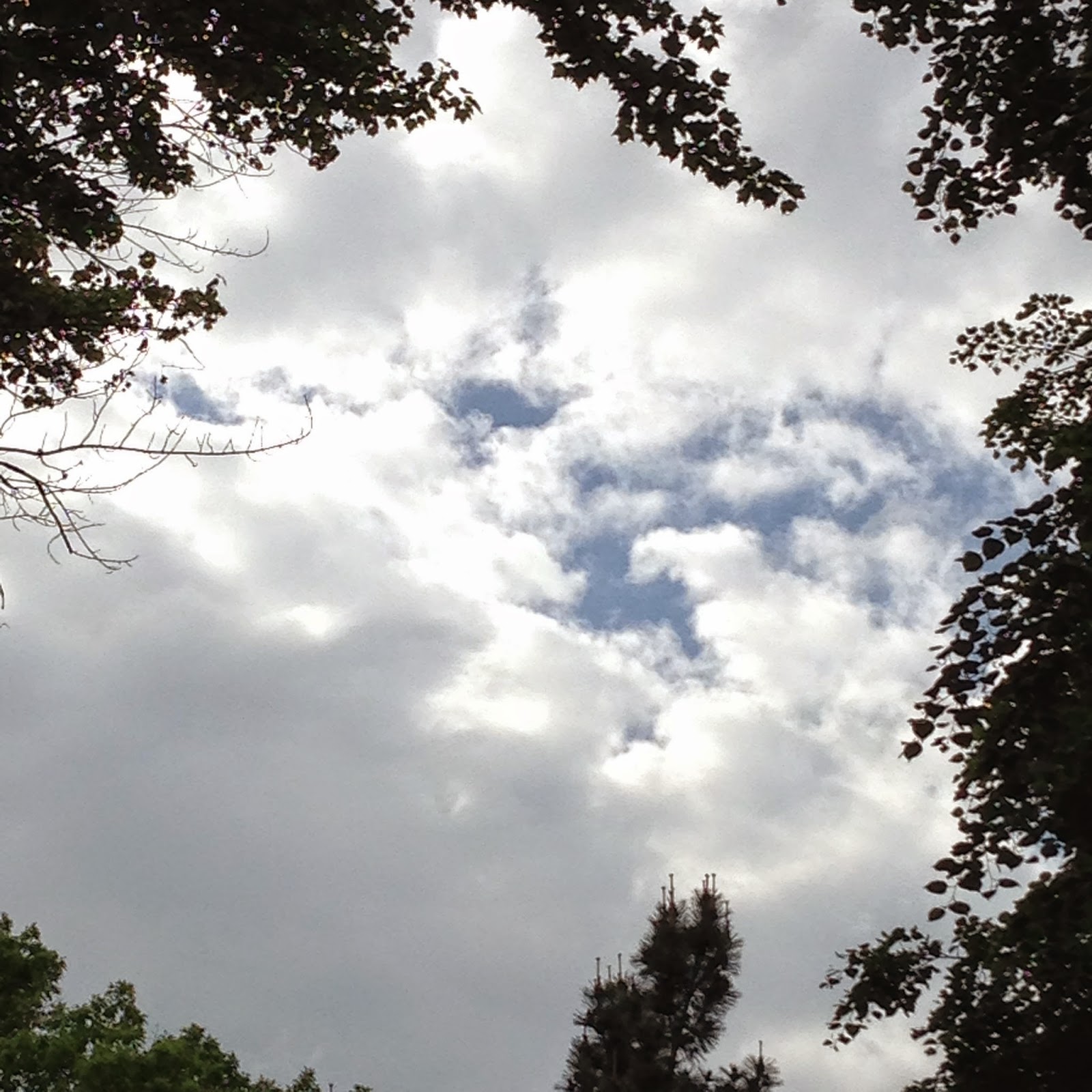
Back home in the backyard

Backyard
"Normal" journaling too often leaves me at a loss.  The impulse to mark something daily, however, remains.  This is especially true right now when I'm traveling so much, so far, and in such a short space of time (Japan, New England, Spain, Hawaii, Korea--all in a two month period.  There's just too much new to process right now.). I found I wanted a daily marker that I didn't have to interpret or read into.  Rather than turn my attention to myself, I've started a daily cloud journal as a way to pay attention to where I am, and the sky's state of being in that place at that time.  This is the first week starting with the airport in Madrid and ending in the backyard at home.  I'm no photographer.  Most of these are shot with my phone.  The idea is just to have a moment each day when I pay attention to the sky.

Thursday, March 27, 2014

Sophisticated Dracula

St. George and the Dragon in the Romanian Art Museum

It's a little slippery here in Bucharest.  Things are close to the same.  It looks like a familiar Western European city with beautiful old buildings and then you drive past block after block of communist era apartments with wild dogs lurking in the alley.


Manastirea Stavropoleos
Or a church that only has one room and is shaped like this picture and has a tiny courtyard full of stoneware in need of repair.  Similar but different: The bent white-haired lady was there kissing icons, but there were so many that this took awhile.  And all the candles were in special brass boxes outside.

That's what it was like in the city's art museum today.  Imposing former palace houses the collection.  That seemed familiar.  The whole first floor is gallery after bright purple-walled gallery of medieval art.  More gold gilt and large sad eyes grace those purple walls than I have ever seen amassed elsewhere.  And it's all Romanian—Muldavian, Transylvanian, etc.

Which is where the sophisticated Dracula comes in.  Vlad the Impaler, though quite the sponsor of churches in his time, does not make an appearance.  His brethren, however, made some very interesting depictions of Christ.  The nearest contemporary example I can think of is that in Transylvanian iconography, Christ looks like a haggard vegan hippie with bags (think luggage) under his eyes.

While that's not the sophisticated part, Transylvania, it turns out, was a melting pot of the time.  Protestant Saxons brought in as artisans to do the church's silver work mingled with Calvinist Hungarians who settled in the region, and Orthodox Romanians.  Over the course of a couple of hundred years they made work that slips from the human to the immortal before your very eyes.  If you'd like to look at it, here's a link: Transylvanian Art at the Bucharest Museum.

Wednesday, March 26, 2014

Bucharest—Romanian Museum of the Peasant

Icon
Doorways were often treated as gateways
Staying in Bucharest for a few days.  First venture into the city alone was to the Peasant Museum.  I don't know much about Romania and have found it difficult to find much real information, so I thought I'd begin here with her heart.  The peasant seems to hold a revered place here as touchstone for identity and imagination, something I began to appreciate in the museum but on my return to the hotel was brought home by a member of the hotel staff.  She was deeply offended by my use of the word "eccentric" to describe the museum's curation even though it was surrounded by "wonderful," "charming," "most unique museum I've visited."  The closest American equivalent I can think of is if a traveller were to tell a Texan that cowboys were ridiculous.


The curation of the galleries was intelligent; sensitive; and, I mean this in the very best sense of the word, weird.  I was reminding of a sensibility you run into in some Russian and Polish film makers' work.  Here the intellectual and the emotional met in place Americans just don't go very often in general and almost never in museums.


Hand drawn signage for work included in a gallery
Let me give you a couple of examples.  In the information placed in the galleries, I ran across lines like "The museum is a road of initiation..." and for an intact peasant house in one of the rooms, "Part of the attic has been put on display, revealing a space not only for storage, but also a place of mystery, which arouses curiosity and fear of the unknown.  It is a gesture of trust and confession..."  In one gallery of wrought iron and wooden artifacts, we were encouraged to not concern ourselves with the intended use of these items, but rather to walk through the room as though through a garden.

Much of the work display was highly engaging and designed to be walked around; or through; or, with catwalks for some of the large structures, above.  There was a wonderful exception, however, in a small grouping of mannequins in peasant clothing (apologies for blurriness of photo)

who seemed more interested in enjoying the view out the window than being the object of any of our fetishizing gazes.

Monday, March 10, 2014

Toe in the river

Realized I felt impoverished, as if I'm not even in the stream — just on the banks watching.  But of course I am, I just have trouble seeing it.  For if there is a real world and I can know a part of it, then I must know my part.  This is what I must not lose for it will be all I have to offer.


I find, however, that I often prefer to look at you, discover your world rather than offer mine.  Henri Bergson, Tielhard de Chardin — my un-knowers and still returning to Donald Davidson for conversation and relief.  I do not think, however, I can do this alone.  I prefer to know a larger world than I can hold — one that lives and we discover.

So I'll begin mid-stream with Emily Dickinson.  The remarkable process of changing how we read continues with The Gorgeous Nothings, ed. Werner & Bervin and Emily Dickinson Unbound: Paper, Process, Poetics by Alexandra Socarides .  For one year Susan Howe came to teach at us at Denver (now a very long time ago) and taught first a writing workshop, then a Melville seminar, and then gave a presentation on Dickinson from which I still remember images ("The Sea said 'Come' to the Brook").  Since then the material nature and/or history of whatever I'm reading offers its own world of intelligence.  

Here are some loose notes on American print culture leading up to and during Dickinson's time as a way to keep thinking about a poet famous for choosing not to print.  These are taken from The Printed Book in America by Joseph Blumenthal.

Summer of 1638:  Reverend Jose Glover brings a printing press to the new academy that would become Harvard. Workmanship with press was poor — not many people trained in the craft as a result of severe restrictions on printing in England (note to self: left over from Milton?).  As Governor Winthrop records, they first print a freeman's oath and an almanac though no copy of either survives.  In 1640, the first book is printed — The Whole Booke of Psalms Faithfully Translated into English Metre.  Translators? John Cotton and Richard Mather.

Permission to establish press comes in 1674.
Not until 1704 does Boston successfully publish a newspaper.

Caslon type, famous for use in Declaration of Independence, is the first major typeface import.
1809 sees first American type issued.


Adobe Caslon


In 1787, 80 or 90 paper making mills operating.  In 1810, there are 195.
13th century European methods where each sheet is individually formed by dipping a wire mold into a vat of pulp paper.  While not well made, it was sturdy due to cotton and linen rag content.

18th century library:  3,000 volume Cotton Mather library in Boston.

19th century:  House of Harper is largest printer in New York.  Integrated new steam presses built by Daniel Treadwell of Boston.  In 1853 could produce 600-900 hand-fed sheets per hour.  
Ground floor — 28 steam driven bed and platen presses.
2nd floor — printed sheets dried and presses
Next 3 floors — folding, gathering, sewing
Top floor — most light — composing type by hand


Like other publishers of the time Harper books were larger editions at low prices for a growing market of readers.  Typefaces were debased copies of Bodoni and Didot.  Books themselves were not considered art, and there was no attempt to make fine books.